

Pharmacy is at a crossroads (those of a certain age will groan at that one). The frontline is increasing in clinical complex – patients arriving with undifferentiated diagnoses via Pharmacy First, supply chain dysfunction creating medicine shortages across many sectors, and funding that hasn’t kept pace with the demands we’re being asked to meet. We are all being asked to do more, with less, and we need to be deliberate about how we respond.
The question isn’t whether pharmacy should evolve. It must. Pharmacy First, medicines optimisation, advanced clinical services—these are not departures from our professional identity; they’re a natural expression of it. We have the clinical expertise to lead in these spaces, and patients and the healthcare system need us to.
But here’s what concerns me: as we’ve embraced this evolution, there’s been a subtle erosion of something fundamental. The safe, effective dispensing of medicines—the clinical governance, the medicines safety work, the careful checking that protects patients every single day—has begun to feel secondary. It’s been reframed as “product distribution” when it’s actually clinical work. Essential clinical work.
We cannot modernise pharmacy by throwing out the baby with the bathwater. We need both. We need the new clinical roles and the foundational safety work that underpins everything. We need a profession that’s recognised for its full scope—from the complexity of clinical decision-making to the precision of medicines governance.
That’s what I believe the Royal College should represent: a voice that refuses to choose between these things, because the profession doesn’t have to.
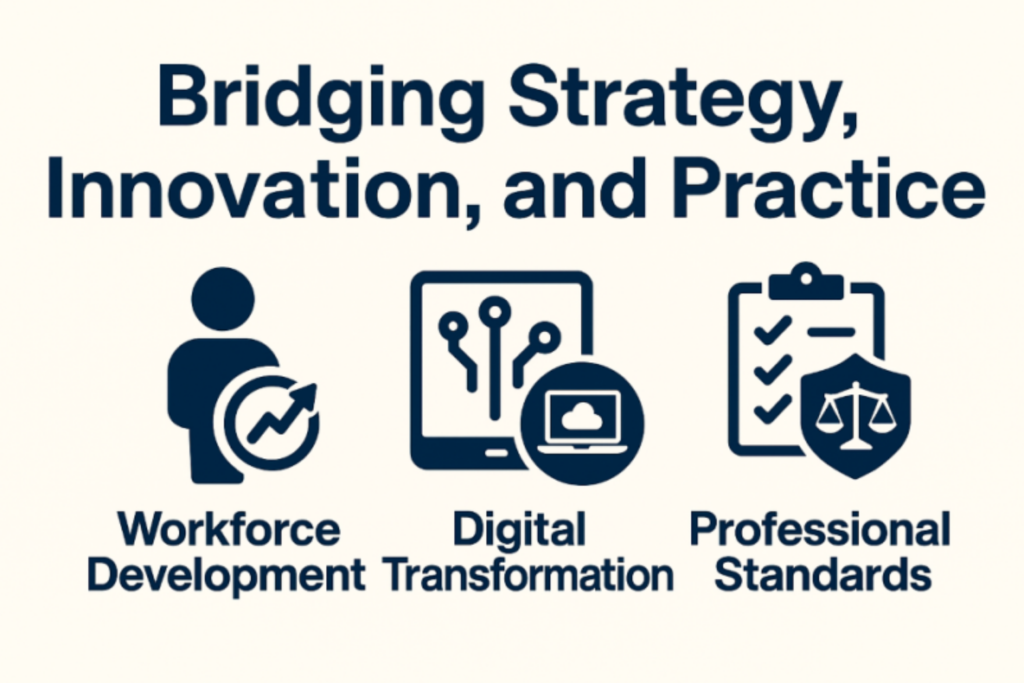
The Three Interconnected Challenges
This isn’t about three separate problems. They’re deeply woven together.
Workforce development and professional standards aren’t luxuries—they’re foundational to everything else we do. If we’re asking pharmacists and pharmacy technicians to work in increasingly complex environments (managing undifferentiated presentations, navigating supply chain pressures, adopting new technologies), we need to invest in their development. We need clear professional standards that define what good looks like. And we need the profession to have a voice in setting those standards, not having them imposed on us.
Bridging NHS strategy with practice reality is where I see the gap most acutely. Strategy gets set at national level—digital transformation programmes, service redesign, funding models—often without sufficient input from those actually delivering the work. The result? Solutions that don’t fit the frontline. Technology that creates more work, not less. Policies that sound good in a boardroom but fracture under the weight of real practice. The Royal College needs to be the mechanism through which we actively translate between these worlds.
And that’s where digital transformation and healthcare AI come in. Technology isn’t the solution by itself. But thoughtfully deployed -shaped by pharmacy’s expertise, aligned with our professional standards, supporting our workforce to do better work – it can genuinely help us manage complexity. It can free us from administrative burden so we can focus on clinical work. It can improve patient safety.
But only if pharmacy shapes it. Only if we’re not passive users, but active voices in how it’s designed and deployed.
What This Means for You
If you’re a community pharmacist navigating Pharmacy First whilst managing medicines shortages and stretched staffing, you know this already. You’re solving complex clinical problems with fewer resources. You’re being asked to do more without the investment in your team’s development or the recognition of what you’re actually doing—which is clinical work, not product distribution.
If you’re in hospital pharmacy or a specialist role, you’re watching digital transformation programmes roll out that don’t fit your workflow. You’re adopting AI tools without clear governance frameworks in place. You’re being asked to innovate while the foundational safety work – the thing that keeps patients safe – feels chronically underfunded.
In academia, you’re designing curricula for the next generation of pharmacists – Independent Prescribers who will need digital literacy, AI fluency, and clinical safety awareness that simply wasn’t required a decade ago. But are we building training that equips them for this reality? Are there clear professional standards guiding how pharmacy educators approach digital skills and technology governance?
Across all sectors – community, hospital, specialist, academic – we’re watching pharmacy’s role in patient safety become invisible in national conversations. We’re not at the table when digital strategy is being set. We’re not being asked what development our workforce needs. We’re not shaping the standards that will govern how we practise.
The Royal College should exist to change this. But only if it’s genuinely representative of the profession’s expertise, actively advocating for pharmacy’s voice, and building consensus around the issues that matter most. That means bringing people into conversation who understand both the strategic landscape and the practice reality – across all sectors. Who know what it takes to keep patients safe. Who refuse to accept that we have to choose between innovation and safety, between new roles and foundational work.
That’s what I want to bring to this role.
My Perspective

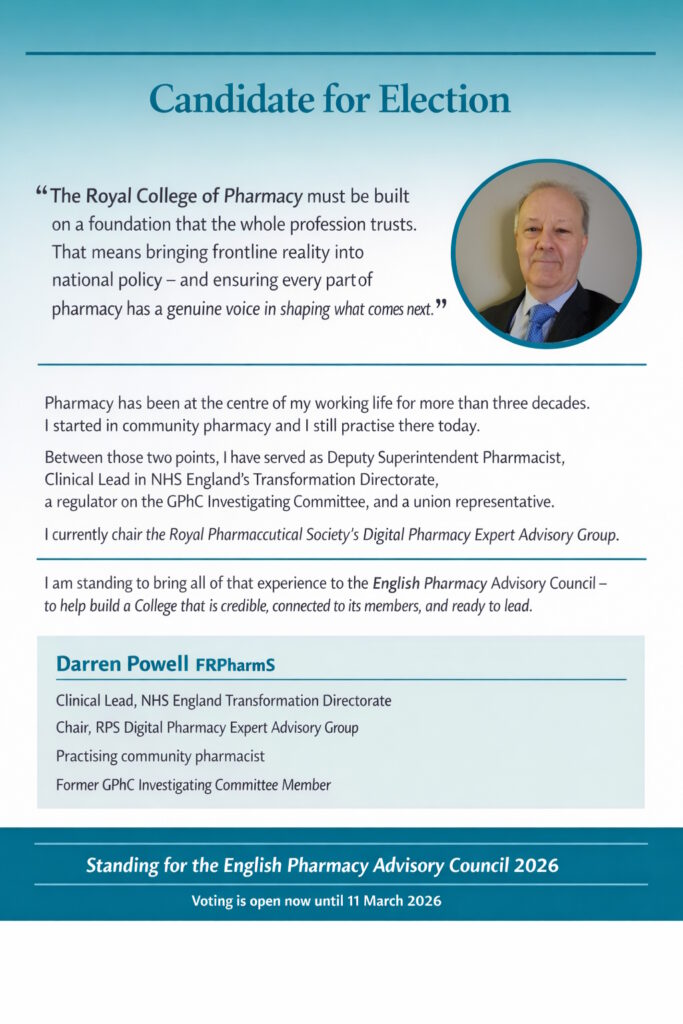
I’ve spent the last decade working at the intersection of clinical practice and digital transformation. I started in community pharmacy, which taught me what frontline reality actually looks like. I moved into NHS informatics and clinical safety, which gave me insight into how strategy gets made, how technology gets deployed, and where the gaps between intention and practice emerge.
That dual perspective – understanding both the boardroom and the frontline- has shown me where pharmacy’s voice is missing most acutely. I’ve seen digital transformation programmes designed without input from practising pharmacists. I’ve watched clinical safety frameworks get implemented without understanding the realities of medicines dispensing. I’ve sat in rooms where pharmacy’s contribution to patient safety was treated as peripheral, when it’s actually foundational.
But I’ve also seen what becomes possible when we get it right. When pharmacists are genuinely involved in shaping digital tools. When professional standards guide implementation. When we invest in workforce development. The difference is tangible – safer, more efficient practice, and a profession that’s energised rather than depleted.
I’m standing for the English Pharmacy Advisory Council because I believe I can help bridge this gap. Not as someone with all the answers, but as someone who knows how to listen to the expertise within our profession, translate between the strategic and the practical, and help build consensus around the issues that matter most.
What’s Next
We’re at a moment where pharmacy’s future gets decided. The choices we make now – about how we integrate technology, how we develop our workforce, how we maintain professional standards whilst evolving our scope – will shape practice for the next decade. And fundamentally, they’ll affect patient safety and the quality of care our patients receive.
The Royal College can be a genuine force in this. Not a rubber stamp for decisions made elsewhere, but an authoritative voice that actively shapes how pharmacy evolves. A mechanism through which our collective expertise – from the frontline to academia, across all pharmacy sectors – informs national strategy. A place where we build consensus around what matters most: patients at the centre, a workforce that’s recognised and supported, and a profession that’s shaping its own future rather than having it shaped for us.
That means bringing the whole pharmacy team – pharmacists, technicians, and specialists – into conversation about how we develop, what standards we set, and what recognition we deserve. Because patient safety and excellent pharmaceutical care aren’t delivered by individuals; they’re delivered by teams.
I’m asking for your support not because I have all the answers, but because I’m genuinely committed to listening, translating, and ensuring that our voice – the voice of the whole pharmacy team – is heard where it counts. We have the expertise, the clinical credibility, and the commitment to patient care. We just need to ensure it’s heard and valued.
Leave a Reply